House of Poker - Texas Holdem
- 4.2
- Rating
- 1.00M
- Installs
- Free
- Price

 Analysis by App-foxy
House of Poker - Texas Holdem is a free card game from MASSIVE GAMING PTY LTD that focuses on tournament-style Texas Hold’em rather than a quiet, purely casual table. I found its strongest identity in the way a short poker session can feel connected to a larger event: you are not only deciding whether to call, raise, or fold, but also trying to manage your position, timing, and risk across a competitive run.
That focus makes it more interesting than a basic poker simulator for players who enjoy pressure and progression. It also creates the main question you should ask before installing it: do you want a relaxed hand-by-hand game, or do you like the extra tension that comes from tournament play and live event tickets? In my experience, this is much better suited to the second group.
The game is free to download and carries a Teen content rating. It has built a sizeable audience, with over a million installs, an average rating of 4.2 from around seventeen thousand ratings, and roughly two thousand reviews. Those figures suggest that the central poker experience connects with many players, although they should not be mistaken for a guarantee that every session will suit your preferred pace.
You May Also Like

 Blood Strike: 2.5 Anniversary
Blood Strike’s Loadouts Turn Every Drop Into a Tactical Gamble
A close look at Blood Strike’s custom loadouts: how fast access to signature weapons reshapes its battle royale rhythm, rewards preparation, and narrows the gap between fights.

 Pandora - Music & Podcasts
Pandora’s Music Is Easy to Start, but Harder to Recover
Pandora’s strength is its low-effort path from a seed to a station. Its weak spot is how much confidence it asks you to place in connection, setup, and quiet recovery.

 8 Ball Pool
 Is Built on Rivalries, Rematches, and Routine
A close look at the rivalries, rematches, shared routines, and unanswered safety questions that turn a quick pool match into a persistent mobile community.

 Samsung Music
’s Quiet Strength Is Playing What You Already Own
Its reach comes less from spectacle than from dependable access to a personal library. That simplicity is both the app’s strongest retention engine and its ceiling.

 AccuWeather: Weather Radar
AccuWeather Review: A Quick, Clear Forecast for Everyday Decisions
For everyday plans, the best forecast is the one you can understand quickly. AccuWeather makes rain timing, radar, and local conditions easy to act on, with a few trade-offs.

 Hill Climb Racing
Why Hill Climb Racing Still Turns Crashes Into One More Run
A tiny car, a bumpy hill and one more upgrade: Hill Climb Racing keeps resurfacing because its simple chaos makes every near-miss feel personal.
More From Our News Desk



Why tournament play changes the experience
Tournament play gives each hand a place in a longer run, so I find it useful to think about what I want from a session before I join one. A clear goal can help me stay patient when the cards are quiet and avoid chasing action after a setback. That shift in focus also makes it easier to notice the signals of progress that matter beyond a single hand.
A poker game built around decisions with consequences
The verified feature that matters most here is tournament play. In a normal casual poker app, losing a hand can feel isolated: you simply wait for the next deal and start again. A tournament structure changes the emotional weight of each choice. Your chips, table position, and remaining opportunities become part of the decision, so a hand is no longer judged only by the cards in front of you.
I like that format because it encourages a more thoughtful rhythm. A weak starting hand is not automatically a reason to gamble just because the next deal is close. Likewise, a strong hand does not always justify pushing everything forward if the situation calls for patience. The useful skill is learning when the table situation matters more than the excitement of seeing another card.
That is also where the game can separate itself from simple free poker alternatives. A basic practice app is often ideal when you want to learn hand rankings or play without pressure. House of Poker is more appealing when you already understand the fundamentals and want those fundamentals tested by a competitive structure.
Live event tickets give sessions a clear purpose
The mention of live event tickets is important because it gives tournament play a destination. Instead of treating every table as an unrelated round, you can approach a session with a specific goal: build carefully, qualify when possible, and avoid throwing away progress for a flashy hand. That goal makes even a short visit feel more deliberate.
I would not describe this as a game for players who only want to pass a few seconds with no commitment. Even when you play briefly, the tournament mindset asks you to pay attention. If you are distracted, rushing, or checking your phone between decisions, you may make choices that are entertaining in the moment but poor for your overall run.
One practical tip is to decide your style before entering a serious session. If you are playing to relax, accept that you may take more risks and enjoy the action. If you are trying to reach a live event, treat early hands as information-gathering opportunities. Watch how aggressively the table behaves, notice which situations tempt you into unnecessary calls, and preserve flexibility for later decisions.
What the format teaches you about your own play
Tournament play can expose habits that remain hidden in ordinary poker games. I noticed that the format makes impatience easier to recognize. When cards are quiet, the temptation is to manufacture action. When the table becomes active, the opposite problem appears: it is easy to stay involved simply because everyone else is committing chips.
That makes the game useful as a personal discipline exercise. I can ask myself whether a decision comes from the strength of the hand, the position at the table, or frustration with waiting. Those questions are more valuable than chasing one dramatic win. The app does not need to turn every hand into a lesson for tournament structure to reveal these patterns naturally.
A second useful habit is separating a bad outcome from a bad decision. A strong choice can still lose, while a reckless call can occasionally succeed. If you judge every move only by its result, tournament play becomes an emotional roller coaster. I get more from the game when I review the reason for a decision instead of treating the final card as proof that the decision was right or wrong.
How I would use it in an everyday situation
Imagine having a half-hour break after work. You open the game intending to play one short session, but you do not want to begin a long campaign that demands constant attention. The tournament focus gives that break a natural shape: enter, make measured decisions, and stop when the session reaches a sensible point rather than endlessly jumping between random tables.
That scenario works best when you are willing to leave a session unfinished or accept a modest result. If you feel compelled to recover every lost chip immediately, a short break can turn into an unnecessarily tense experience. I would use House of Poker during a focused pause, not while commuting, cooking, or doing anything that makes it difficult to watch the table.
It can also work as a social conversation starter among friends who already enjoy Texas Hold’em. The tournament angle gives everyone something to discuss beyond who received the best cards: when to protect a lead, whether a risk was justified, and how the event structure changed the value of patience. For a group that prefers completely private play, however, a local or offline alternative may feel more comfortable.
Free entry does not mean friction-free play
The game is free, which makes it easy to try without committing money upfront. That is a meaningful advantage for anyone comparing several poker apps. You can first decide whether the tournament pace and event-oriented structure fit you before considering whether the wider experience deserves more of your time.
There are in-app purchases ranging from less than a dollar to amounts reaching into the hundreds for an individual item. I would treat that range as a reason to set a personal spending boundary before playing. The safest approach is to regard purchases as optional entertainment spending, never as a way to repair a poor decision or chase a disappointing result.
This matters especially in a tournament-focused game because the desire to continue can feel stronger after a setback. If you lose a promising run, the emotional response may be to look for a faster route back into the action. I recommend taking a break at that point. A purchase should be a planned choice made calmly, not a reaction to frustration.
For families, the Teen rating is another practical consideration. It is not a children’s card game in the way a simple matching game might be. Parents should decide whether the competitive format and purchase options are appropriate for the person using the device, and they should make sure spending controls match their household rules.
Where it stands beside ordinary poker alternatives
Compared with a poker app designed mainly for learning, this game places more emphasis on pressure, momentum, and tournament objectives. A beginner who still needs help understanding hand rankings may prefer a slower teaching tool first. House of Poker becomes more attractive once the basic rules are familiar and the player wants to make choices under changing circumstances.
Compared with a purely casual Texas Hold’em game, the event structure gives sessions more direction but also removes some of the carefree feeling. You may enjoy the added purpose if you like competition. You may prefer another option if your ideal poker experience is simply dealing hands until you feel like stopping.
It also differs from a traditional home game. Around a real table, conversation and body language are part of the entertainment. Here, the appeal is more concentrated on the card decisions and the tournament setting. I would choose this app when I want a convenient digital poker session, not when I am looking for the full social atmosphere of playing with people in the same room.
Small habits that improve the tournament experience
My first recommendation is to avoid treating every hand as a test of courage. Folding can be the action that protects your next opportunity, especially when the table is moving quickly or your position is uncomfortable. The game is more enjoyable when you accept that waiting is part of playing well.
Second, create a stop point before you begin. It could be the end of a tournament attempt, a fixed amount of time, or simply the moment you notice that you are making rushed decisions. This is not just about responsible spending. It also protects the quality of your play, because tired or irritated decisions are rarely a fair test of your poker judgment.
Third, use event goals to shape your risk rather than letting them dictate every move. A ticket objective can encourage discipline, but it can also make you overly cautious. There are moments when a calculated risk is necessary. The useful balance is to preserve enough room to respond later while still taking opportunities that genuinely improve your position.
Finally, keep your expectations realistic. No tournament format removes luck from poker. A careful approach can improve your decisions without guaranteeing a particular result. If you enjoy the process of choosing well, the game has more to offer than if your only measure of success is finishing first.
Who will get the most from it
I think House of Poker is a strong match for an intermediate Texas Hold’em player who wants more structure than a basic free-play table provides. The tournament focus rewards patience, makes short sessions feel purposeful, and creates a reason to think about the relationship between one hand and the wider event.
It is also a reasonable choice for someone returning to poker after a break. You can use the familiar rules as a starting point, then rebuild confidence by paying attention to timing and risk rather than trying to play every hand aggressively. The free price makes that trial less intimidating, provided you keep the purchase range in mind and decide your limits in advance.
I would be less likely to recommend it to a player seeking a quiet offline pastime, a detailed poker classroom, or a completely consequence-free experience. Those needs are better served by a simple practice game or a traditional casual alternative. I would also skip it if competitive event pressure makes card games feel stressful instead of fun.
Device details and overall usability
The game was released on May 18, 2020, and its current version is 1.13.1. It supports devices running Android 7.1 or later, so owners of older compatible phones may still be able to try it without needing a recent operating system. That broad compatibility is helpful for players who keep a dependable older device for games.
Still, compatibility alone does not decide whether it belongs on your phone. Poker requires concentration, and a small or aging device can make a longer session less comfortable even when the game runs. I would test it during a normal session rather than judging it only by whether it opens. The important question is whether you can follow the tournament flow without rushing decisions or losing track of your objective.
The developer, MASSIVE GAMING PTY LTD, has positioned the product around Texas Hold’em, tournament play, and live event tickets rather than presenting it as a collection of unrelated card games. That clear identity is one of its strengths. You know what kind of experience you are installing, and the decision to keep playing depends largely on whether that focused format appeals to you.
My final recommendation
After spending time with its tournament-centered approach, I see House of Poker as a focused poker game rather than a universal replacement for every card app. Its best quality is the way it gives decisions a longer shadow. A fold can protect a future opportunity, a reckless call can damage an otherwise promising run, and a live event goal can make patience feel worthwhile.
The trade-off is that the same structure can add pressure. The free download is inviting, but the in-app purchase range means I would play with clear limits and avoid making spending decisions while chasing a result. The Teen rating also makes it more suitable for older players who understand both the competitive tone and the importance of controlled spending.
My recommendation is simple: try it if tournament poker sounds more appealing than endless casual hands. Give it a fair session, pay attention to how the event structure affects your decisions, and decide whether that added purpose improves the game for you. If it does, this is a convenient and engaging way to practice patience, timing, and risk management in Texas Hold’em. If you only want a relaxed hand whenever you have a spare minute, a simpler poker alternative will probably feel more natural.
FAQs for House of Poker - Texas Holdem
01What is House of Poker - Texas Holdem?
House of Poker - Texas Holdem is a mobile poker game focused on Texas Hold’em, allowing players to compete in poker tables using virtual chips. It is designed for casual play, practice, and online-style competition rather than real-money gambling. The game typically includes different tables, opponents, and progression features, so new players can learn the basics while experienced users can test their decision-making skills.
02Can I play House of Poker - Texas Holdem without spending real money?
Yes, the game is generally built around virtual chips rather than direct cash wagering. Players can usually join tables, win chips, and continue playing without making a financial deposit. However, optional in-app purchases may be available for additional chips or other items. Before downloading, it is worth checking the current store description and purchase settings, especially if children may use the device.
03Does House of Poker - Texas Holdem require an internet connection?
An internet connection may be required for features involving online tables, account synchronization, leaderboards, advertisements, or multiplayer competition. Some parts of the experience may work offline, but availability can depend on the version installed and the device platform. For the most reliable experience, use a stable Wi-Fi or mobile data connection and check whether the game supports offline play in its latest release notes.
04Is House of Poker - Texas Holdem suitable for beginners?
The game can be suitable for beginners because Texas Hold’em is based on a clear set of rules, and mobile poker apps usually make it easy to follow turns, bets, and available actions. New players should still learn hand rankings, blinds, betting rounds, and basic bankroll management. Since the game uses virtual chips, it can provide a less pressured way to become familiar with poker before playing against more experienced opponents.
05Are there advertisements or in-app purchases in House of Poker - Texas Holdem?
House of Poker - Texas Holdem may include advertisements and optional in-app purchases, depending on the version, region, and platform. Purchases can potentially provide virtual chips, bonuses, or other progression-related benefits, while ads may appear between sessions or during certain parts of the game. Review the app-store listing for the latest pricing and content information, and use parental controls if purchase access needs to be restricted.
Pros
- Quick matchmaking keeps casual games moving.
- Clear card layouts make hands easy to follow.
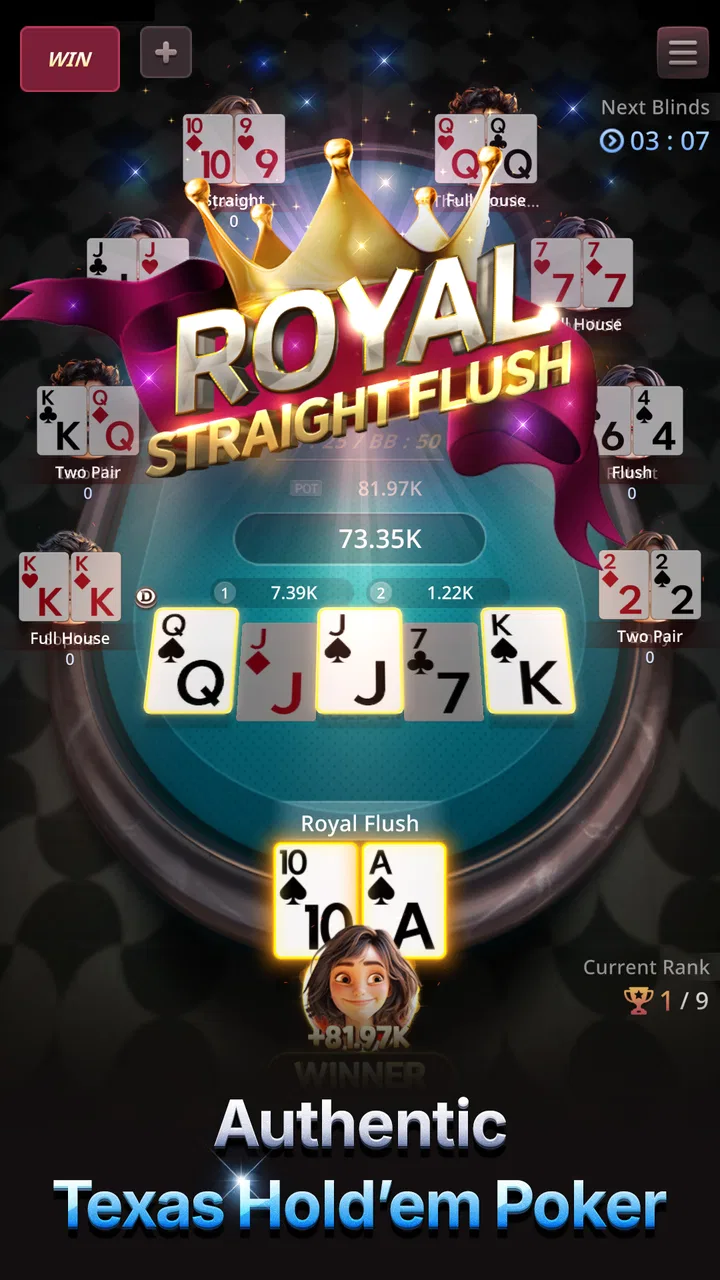
- Chips and tables create an authentic poker atmosphere.
- Practice-friendly format helps new players learn Texas Hold’em.
- Short sessions fit well into quick breaks.]
- contras:[
- Progress may feel slow without frequent play.
- In-game purchases can affect how quickly you build resources.
- Random matchmaking may create uneven skill levels.
- A stable internet connection is required for online tables.
- Poker sessions can become repetitive over time.
Cons
- Progress may feel slow without frequent play.
- In-game purchases can affect how quickly you build resources.
- Random matchmaking may create uneven skill levels.
- A stable internet connection is required for online tables.
- Poker sessions can become repetitive over time.

House of Poker - Texas Holdem
Gallery